Année du premier vol (ou de design, si seul projet)
1955
Pays
Hongrie
Designer(s)
ZSEBÕ, Ferenc & al.
Premier constructeur
Central Workshop of the Hungarian Aeronautical Association, Dunakeszi
Type d'appareil
Planeur - Monoplan
Mode de propulsion
--
Fonction
Voltige
SPÉCIFICATIONS TECHNIQUES
Envergure
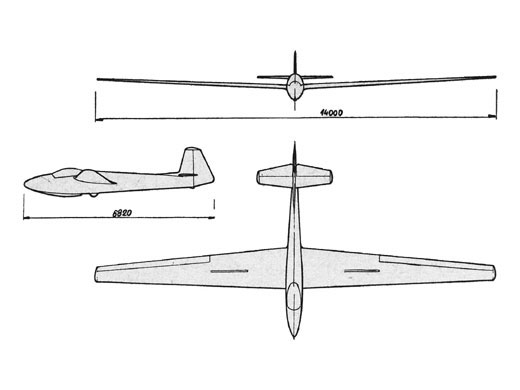
14 m
Longueur
6.82 m
Hauteur
--
Allongement
14.3
Surface alaire
13.7 m2
Profil principal
NACA 23015
Profil - Remarques
--
Masse à vide
230 kg
Masse maxi
370 kg
Charge alaire
27.1 kg/m2
Vitesse mini
--
Vitesse maxi
400 km/h
Finesse maxi
24 à 90 km/h
Taux de chute mini
1 m/s à 83 m/s
Nb sièges
1
Structure
Fuselage et empennage en métal léger. Ailes en bois, monolongeron, entièrement coffrée en contreplaqué.
[The world's sailplanes, Die Segelflugzeuge der Welt Les planeurs dans le monde - collection J-M. Mesot] [The world's sailplanes, Die Segelflugzeuge der Welt Les planeurs dans le monde - collection J-M. Mesot]
AUTRES INFORMATIONS
Constructeur(s)
Constructeur
Construits
Central Workshop of the Hungarian Aeronautical Association, Dunakeszi
1
Nombre total de constructions
1
Infos techniques
The split ailerons were differentiated, however unusually the inner ailerons had greater deflections than the outer ones. The reason of this solution was to get a more even load distribution on the wing. Toutes les commandes sont équilibrées. -2 degrés de vrillage aux ailes.
Histoire résumée
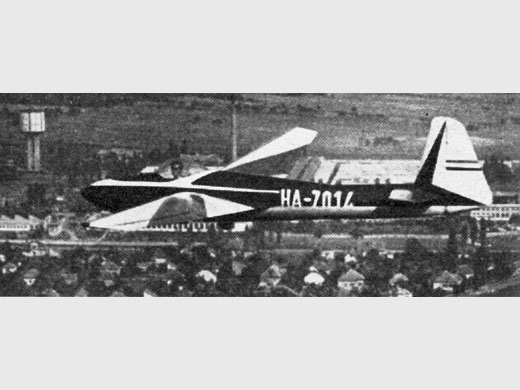
In 1954 to replace the phasing out popular aerobatic glider, LF-107 Lunak, a fully aerobatic glider was ordered by MÖHOSZ, the central organization controlling all the flying sports in Hungary, from the Central Workshop of the Hungarian Aeronautical Association, Dunakeszi. Based on the experiences had been gained operating Lunaks, the basic requirements formulated for the new glider were harmonized controls with light control forces, high terminal diving speed and small height loss when flying aerobatic figures. The general arrangement and the dimensions were based on those of the Lunak. The fuselage of the new glider was an all-metal structure, however the wings had a conventional wooden structure. The idea was to redesign the wing as an all-metal structure in case the type turns out to be a success.
The terminal speed used in the calculations was 400 km/h. Generally such high speed is not required by glider aerobatics, however the designers took into account the mistakes frequently encountered in aerobatics training.
The prototype first flew at June, 1955 and quickly became a preferred performer at airshows. In 1956 performed in Vienna and in 1958 at Tusino airfield in Moscow. In spite of its popularity only one example was built.
Liens personnalités
Pas de personnalité associée
Exemplaires existants
Immatriculé : OE-0523 (En exposition), localisation : Flugmuseum Aviaticum, Lichtenwörther Str. 4, 2700 Wiener Neustadt, (AT)